
Eyewear Barrel Tumbling Polishing Process: Frame Finishing at SHJM Optical
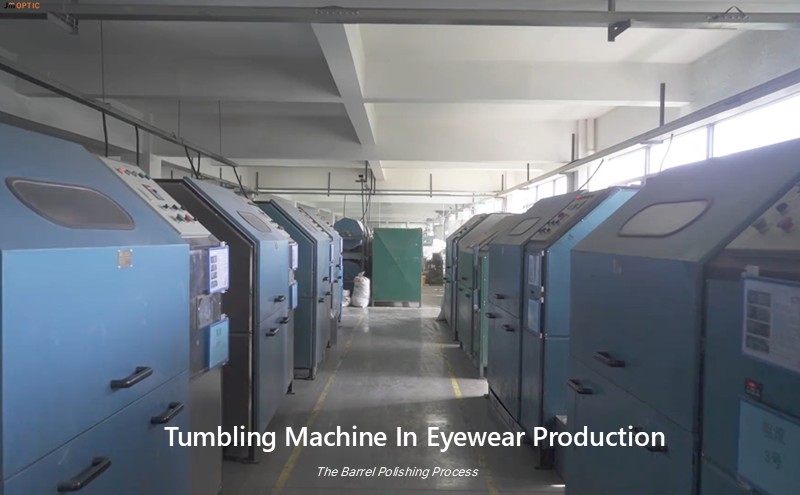
Why Eyewear Frames Spend Days in a Tumbling Machine — The Barrel Polishing Process Explained
Barrel tumbling eyewear frames is one of the most time-consuming steps in professional eyewear manufacturing — and one that separates quality factories from those cutting corners. At SHJM Optical, the eyewear barrel tumbling polishing process is one of the most critical steps in creating smooth, burr-free acetate and metal frames. If you've ever wondered why a pair of metal eyewear frames takes so long to produce — part of the answer lies in a machine you've probably never seen: the barrel tumbler. At JM Optical's Wenzhou factory, metal frames typically spend around 3 days inside a rotating tumbling machine before they're ready for plating, while premium acetate frames can go through a total of 4 to 6 days of barrel polishing. This step isn't optional. It determines surface quality, plating adhesion, and ultimately — the feel and durability of the finished product in the hands of your customers.
🎥 See it in action: Watch our factory video — Inside a Metal Eyewear Barrel Tumbling Machine (1,300+ views in 3 days on YouTube)
What Is Barrel Tumbling in Eyewear Manufacturing?
Barrel tumbling — also called barrel polishing or vibratory finishing — is a surface treatment process used extensively in the eyewear industry. Frames (or individual components) are loaded into a large drum-shaped machine along with abrasive media and, often, a polishing compound. The drum rotates continuously, causing the frames and media to tumble against each other, gradually grinding away surface imperfections. Our eyewear barrel tumbling polishing process uses high-quality media to ensure consistent results.
The goal isn't just cosmetic smoothness. Barrel tumbling serves several critical functions:
- Removing sharp edges, burrs, and mold marks left from machining or die-casting
- Achieving a consistent surface texture across thousands of frames in a batch
- Preparing the frame surface for plating, coating, or further hand-polishing
- Reducing micro-stress points that could otherwise become fracture points under wear
Metal Eyewear Frames: The Barrel Tumbling Process
Metal eyewear frames — whether stainless steel, monel, or titanium alloy — go through barrel tumbling as a mandatory step between machining/die-casting and electroplating.
Standard Process: ~3 Days
At our Wenzhou factory, the standard barrel tumbling cycle for metal frames runs approximately 72 hours (3 days). During this time, the frames are loaded together with abrasive stone media and rotate continuously in the drum. The slow, sustained friction removes casting lines, sharpens edges, and brings the alloy surface to a uniform matte smoothness — the ideal state for electroplating.
Premium Process: Rough Tumbling + Bright Tumbling
For higher-end metal frames, a two-stage process is used:
- Rough tumbling (粗滚): ~3 days with abrasive stone media. Removes casting residue and levels the surface.
- Bright tumbling (光滚): ~10 hours with walnut shell granules or corn cob media and polishing compound. This final stage brings a uniform sheen and smooths the surface to a near-mirror finish — essential for achieving consistent color and shine during electroplating.
The walnut shell stage in particular is worth noting: natural granule media is gentle enough to refine without scratching, and its irregular shape reaches into recessed areas — hinges, nose bridge undersides, temple joints — that flat abrasives cannot.
Acetate Eyewear Frames: The Barrel Tumbling Process
Acetate (cellulose acetate) frames follow a different but equally demanding tumbling regimen. The material itself — a dense, layered plastic — responds differently to abrasion than metal and requires multiple passes to develop the signature deep lustre that makes premium acetate frames so desirable.
Standard Process: 3–4 Cycles, 96+ Hours Total
For premium acetate frames, barrel polishing typically involves a minimum of 3 to 4 separate tumbling cycles, with the total time exceeding 96 hours. Each cycle uses progressively finer media and polishing compounds, gradually building the gloss. Skipping stages or shortening cycles produces a noticeably inferior surface — dull, slightly hazy, or inconsistently polished across frame sections.
High-End Process: 6 Days of Two-Stage Polishing
Some premium products go further still, using a 6-day schedule:
- Rough polishing (粗抛): 3 days with coarser media to remove CNC machining marks and shape the frame surface.
- Fine polishing (精抛): 3 days with fine media and wax compound to achieve the optical-grade surface clarity expected of luxury acetate.
This 6-day process is what separates genuine premium acetate eyewear from budget alternatives. You can often identify under-polished acetate by touch: it feels slightly rough or shows micro-scratches in direct light. Properly tumbled acetate feels almost glass-like.
Metal vs Acetate: Barrel Tumbling at a Glance
|
Specification |
Metal Frames |
Acetate Frames |
|
Main material |
Stainless steel / monel / titanium alloy |
Cellulose acetate sheet |
|
Standard duration |
~72 hours (3 days) |
96+ hours (3–4 cycles) |
|
Premium duration |
3 days rough + 10 hrs bright tumbling |
3 days rough + 3 days fine polishing (6 days total) |
|
Typical media |
Abrasive stone + walnut shell granules |
Progressive abrasive + wax compound |
|
Primary purpose |
Surface prep for electroplating |
Building lustre and optical clarity |
|
Quality impact |
Plating adhesion, color uniformity |
Gloss depth, tactile premium feel |
Why This Matters for Buyers: The Quality Signals
As a wholesale or private-label eyewear buyer, barrel tumbling is one of the clearest quality differentiators between suppliers — and one of the easiest to overlook when comparing price quotes.
Here's what to look for when assessing whether a supplier is cutting corners on tumbling:
- Surface feel: Premium acetate should feel almost waxy-smooth under a fingertip. Metal frames should feel uniformly satin or glossy — no rough patches near hinges or rivet points.
- Plating consistency: Uneven electroplating (patchy colour, thin coverage on edges) often traces back to inadequate surface preparation — i.e., insufficient tumbling.
- Edge sharpness: Any sharp or "raw" edges on acetate temples or metal fronts indicate the polishing stage was shortened.
- Long-term durability: Frames with proper surface prep hold plating longer and resist micro-cracking — directly affecting customer returns and brand reputation.
When you request samples from a supplier, hold the frames up to a strong light source and run your finger along the inner temple edge. That 10-second test tells you more about production quality than any factory audit document.
How JM Optical Approaches Barrel Tumbling
At JM Optical, barrel tumbling is a non-negotiable step in our Wenzhou production line — not a variable we adjust based on schedule pressure or cost targets.
For metal frames, we run the full 72-hour standard cycle for all production orders. For clients requesting premium finishing — particularly frames destined for European or Japanese markets — we add the 10-hour walnut shell bright tumbling stage as standard practice.
For acetate frames, our baseline is 4 cycles over 96+ hours. Premium collections that require deep gloss and luxury tactile quality use our 6-day two-stage process.
After the eyewear barrel tumbling polishing process, frames are inspected for smoothness and quality. This automated eyewear barrel tumbling polishing process improves both the appearance and durability of our frames.
We do not compress these timelines to meet a faster shipping schedule. If a production plan requires tighter timelines, we communicate that clearly and agree on adjusted expectations with the client — rather than silently shortcutting a process the customer can't see but will eventually feel.
FAQ
Q: Why does barrel tumbling take so many days? Can it be done faster?
The duration is determined by material physics, not factory pace. Abrasive action is gradual by design — rushing it produces uneven surfaces. Industrial vibratory systems can accelerate some stages but cannot replace sustained rotation for deep surface refinement. Shortcuts here are detectable in the final product.
Q: Does tumbling time affect my lead time?
Yes, but it's built into our standard production schedule. Our quoted lead times (7 days for ready stock; 60–90 days for OEM/ODM production) already account for the full tumbling cycle. This is why our lead times are honest — we don't quote 30 days and then skip polishing to hit the date.
Q: Can I request the premium tumbling process for all my orders?
Yes. If your target market expects premium surface quality — particularly for branded, private-label, or high-end channel distribution — we can specify the extended tumbling process in your production agreement. It adds time but not much on cost, as the media used are standard consumables at our factory.
Q: How does barrel tumbling relate to electroplating quality?
Electroplating quality is almost entirely determined by surface preparation. Plating bonds to the metal substrate — a rough, inconsistent surface means uneven plating thickness, poor adhesion, and accelerated wear. A well-tumbled frame accepts plating evenly, resulting in uniform colour, correct thickness, and durability that holds up to salt spray and sweat tests.
About JM Optical
JM Optical (Shanghai JM Optical Co., Ltd.) is a manufacturer and exporter of optical frames, sunglasses, reading glasses, and blue-light-blocking eyewear. Our products are manufactured at our Wenzhou factory, with design and development based in Shanghai.
We work with wholesale buyers, private-label brands, and distributors in Europe, the Americas, and the Middle East. Minimum order quantities start at 12 pairs per colour for ready stock, and 300 pairs per style / 100 pairs per colour for custom OEM/ODM production.
Lead times: 7 days for ready goods; 60–90 days for OEM/ODM models.
Website: shjmoptical.com | Email: jim@shjmoptical.com | WhatsApp: +86-137-6415-0962
© JM Optical 2026 · Internal content reference · Designed in Shanghai, manufactured in Wenzhou