
How to find right eyewear manufacturers in China? (IV)
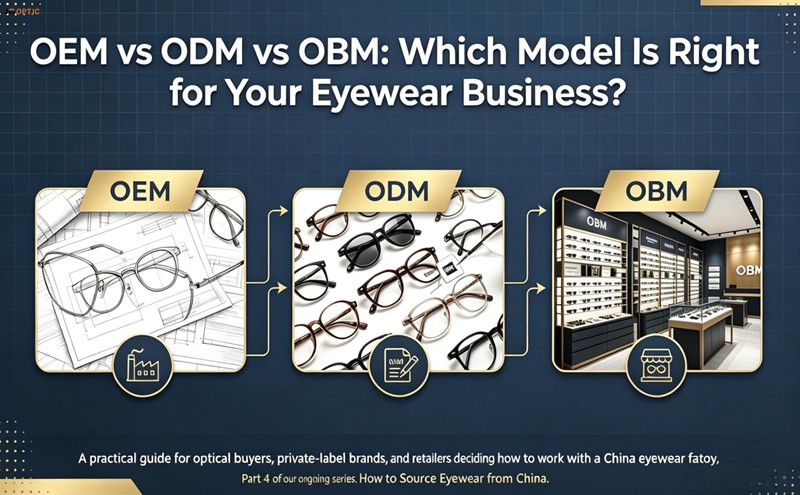
OEM vs ODM vs OBM: Which Model Is Right for Your Eyewear Business?
This guide compares **eyewear OEM vs ODM vs OBM** to help you choose the best sourcing model for your optical business. A practical guide for optical buyers, private-label brands, and retailers deciding how to work with a China eyewear factory.
If you're sourcing eyewear from a China factory, you'll encounter three production models almost immediately: OEM, ODM, and OBM. OEM (Original Equipment Manufacturer) means you provide the design and the factory produces it. ODM (Original Design Manufacturer) means you choose from the factory's existing designs and add your branding. OBM (Original Brand Manufacturer) means the factory sells under its own brand. Which model is right for your business depends on your budget, brand ambition, order volume, and design capability. This guide breaks down each model clearly — with real MOQ numbers, lead times, and cost benchmarks from a factory that works across all three.
📌 This is Part 4 of our ongoing series: "How to Source Eyewear from China." For context, see Part 1 (Manufacturing Hubs), Part 2 (Finding Suppliers), and Part 3 (Evaluating Suppliers).
Eyewear OEM vs ODM vs OBM: Full Comparison for Buyers
OEM — Original Equipment Manufacturer
In an OEM arrangement, you bring the design. You provide technical drawings, 3D files, or physical reference samples. The factory manufactures your design to your exact specifications. The finished product carries your brand, your logo, and your identity — the factory is the production partner, not the designer.
In eyewear, OEM means:
- Custom frame shapes or sizes developed by your design team
- Your logo could be stamped, laser-engraved, or embedded during production
- Your packaging, case design, and retail presentation could also be custom if meet moq.
- IP ownership of the finished design rests entirely with you
ODM — Original Design Manufacturer
In an ODM arrangement, you select from the factory's existing design library. The factory already developed the frame — molds are cut, samples exist, the design is production-ready. You customize the details: color, temple length, logo placement, lens tint, packaging.
For many eyewear buyers, however, the process often goes a step further: you may have a rough idea or reference images, but no finalized drawings or technical specifications. In this case, you rely on the factory to co-develop and refine the style with you. This is where the factory’s production experience and engineering expertise become critical — to anticipate and avoid mass production risks, reduce potential defects, and ensure the design is not only visually appealing but also technically feasible to manufacture consistently at scale.
Through adjustments and technical refinements, the factory balances five core objectives:
- High visual appeal, matching your brand’s style and target market
- Consistent quality and reliable performance in large-scale production
- Low defect rates, even with complex shapes or materials
- Reasonable or short lead times, without compromising quality
- Cost-effective implementation, so the final product fits your budget
In eyewear, ODM means:
- Choosing from a catalog of existing frame styles (hundreds to thousands of options at a typical China factory)
- Customizing colorway, engraving, or minor dimensional adjustments
- Collaborating on style development based on your rough ideas or reference images, with the factory handling technical refinement for production readiness
- Lower MOQs and faster lead times compared to full OEM
- The same base mold may be used by other buyers — differentiation comes through branding, colorway, and design refinements
ODM is the dominant model for small-to-mid-size eyewear brands, first-time buyers, and retailers who want to introduce unique styles that reflect their brand identity without investing in full in-house design capabilities. It balances speed, cost, and reasonable customization, while leveraging the factory’s engineering and production expertise to bring your creative ideas to life reliably and profitably.
OBM — Original Brand Manufacturer
OBM refers to a factory that has developed its own brand and sells finished products under that brand name — either directly to consumers or through distribution channels. The factory is both producer and brand owner.
For most international B2B buyers, OBM is not the relevant model. You would only encounter OBM if a factory is pitching its own-label products to you as a wholesale reseller, rather than offering white-label contract manufacturing. Most sourcing relationships with China eyewear factories are OEM or ODM territory.
OEM vs ODM: A Direct Comparison for Eyewear Buyers
OBM is excluded from this table — it is rarely the relevant model for B2B import buyers.
Factor | OEM | ODM |
Design ownership | You own the design entirely | Factory owns base mold; you own your customizations and refined design elements |
Design input required | High — drawings, specs, or samples required | Low to medium — you can select from existing catalog styles, or share rough ideas/reference images for co-development |
MOQ (per style) | 300–500 pcs typical | 100–300 pcs for custom/refined designs; 12 pcs for stock styles |
MOQ (per color) | 100 pcs | 12-100 pcs |
Lead time | 60–90 days (tooling + sampling + production) | 7 days (stock); 30–90 days (custom color or co-developed designs) |
Tooling / mold cost | USD 200–800+ per component | None — base molds already exist; no extra tooling cost for refinements |
Sample cost | USD 100–300 per sample | USD 20–50 (sometimes free for stock; higher for co-developed samples) |
Product exclusivity | High — unique frame shape | Low to moderate — shared base mold; differentiation comes from your custom color, branding, and design refinements |
Branding options | Full: shape + logo + color + packaging | Moderate to full: logo, color, packaging, plus custom refinements to match your brand style |
Best for | Established brands with own design IP | New entrants, test orders, fast-to-market brands, and mid-sized buyers with rough style ideas but no full technical drawings |
Risk level | Higher (investment before final product seen) | Lower (proven base design; factory’s engineering expertise reduces production risks) |
How to Choose: A Decision Framework
The right model isn't the "best" model — it's the one that matches where you are right now in your brand journey.
Choose ODM if:
- You're entering eyewear for the first time and want to test demand before investing in a proprietary design
- Your budget doesn't allow for upfront tooling costs
- You need product quickly — weeks, not months
- You have branding and packaging ready, but limited or no in-house product design capability
- You have rough ideas, reference images, or style preferences, but no finalized drawings or technical specs
- Your customers choose based on brand story and price, not frame exclusivity
Choose OEM if:
- You have a specific design that doesn't exist in any factory's catalog
- Product differentiation is core to your brand's value proposition
- You have the volume to justify tooling investment (typically 300+ pcs/style per run)
- You've already tested the market with ODM and are ready to go proprietary
- You're in a regulated market where you need to control every material specification for compliance
The Path Most Brands Take: Start ODM, Move to OEM
This is the most common trajectory for independent optical retailers, boutique eyewear brands, and even some larger buyers entering a new product category. You launch with ODM products that let you test demand, gather customer feedback, and understand what your market actually wants — before committing USD 5,000–10,000+ in design and tooling to a proprietary OEM collection.
We've watched dozens of buyers go through this cycle. The ones who succeed long-term almost always start with ODM to reduce risk, then graduate to OEM when they have both the demand signal and the budget to back it up.
What This Looks Like in Practice — A Factory Perspective
At JM Optical, we work with both OEM and ODM buyers. Here is how those conversations typically go:
A typical ODM inquiry (two common scenarios):
Scenario 1: Select from existing styles
"I'm looking for acetate optical frames — round shape, tortoiseshell color, my logo on the temple. MOQ around 50 pairs per color. Can you send a catalog?"
What this buyer receives: a curated selection from our existing design library, color options for their preferred styles, a sample within 7–14 days, and production completion in 30–45 days or even shorter once the sample or picture is approved.
Scenario 2: Co-develop based on rough ideas or references
"I love the look of this reference style, but I want to adjust the proportions, add a subtle detail on temple, and adjust the A size and B size a little of lens shape . I don't have technical drawings, but I know the style I'm going for. Can you help to develop the model into a production-ready frame?"
What this buyer receives:
- A collaborative refinement process, where we translate your vision into a feasible design
- Technical adjustments to ensure the style is both visually appealing and production-friendly
- Prototyping to test fit, comfort, and durability
- A sample within 30–60 days, with production timelines adjusted based on complexity
This is where the factory’s engineering and production experience truly adds value — we help you balance aesthetics, quality stability, low defect rates, lead times, and cost-effectiveness, even when you don’t have a fully developed design.
A typical OEM inquiry:
"We have a designer who has created 4 frame silhouettes. I'm attaching technical drawings and target specs. We need samples in 6 weeks and a quote for 500 pcs per style."
What this buyer receives: a technical review of their drawings, a mold cost breakdown by component, confirmed sampling timeline (3–6 weeks for mold + first sample), and a production quote against their exact specification.
Logo and Branding: What Is Possible in OEM vs ODM
One of the most common questions from first-time buyers: "Can I put my own logo on the frame even if I didn't design it?"
Yes. In an ODM arrangement, your logo can be applied via:
- Temple engraving or stamping (most common — inner or outer temple arm)
- Acetate inlay — logo printed or embedded in the acetate sheet during material production (higher volume)
- Metal plate with logo riveted or glued to the temple
- Lens logo etching
- Custom branded packaging, case, and cleaning cloth — fully available regardless of frame model
In an OEM arrangement, all of the above are available, plus:
- Proprietary frame shape and dimensions unique to your brand
- Custom colorway developed specifically for your order — not available to any other buyer
- Full IP documentation if required for retail channel compliance or brand registration
MOQ and Pricing: Realistic Benchmarks for Each Model
This is where many buyers make their first mistake — expecting OEM pricing at ODM MOQs, or vice versa. Here is a realistic picture based on current JM Optical production parameters:
Cost Item | OEM | ODM |
MOQ (per style) | 300–500 pcs typical | 100–300 pcs for custom/refined designs; 12 pcs for stock styles |
MOQ (per color) | 100 pcs | 12–100 pcs |
Tooling / mold cost | USD 200–800+ per component | None — base molds already exist; no extra tooling cost for refinements |
Sample cost | USD 100–300 per sample | USD 20–50 (sometimes free for stock; higher for co-developed samples) |
Unit price range | USD 5–18+ (material & complexity dependent) | USD 3–12+ (material & complexity dependent) |
First order investment (est.) | USD 2,000–10,000+ | USD 300–1,500 |
Prices are indicative for optical frames in acetate or standard metal. Titanium, bio-acetate, and specialty materials will vary. Contact us for a quote specific to your project.
FAQ
Q: Can I start with ODM and switch to OEM for the same design later?
Not directly — ODM uses the factory's molds, which they own. To go OEM on a similar design, you commission your own mold. Some buyers use an ODM product to validate a concept, then invest in a custom mold with minor modifications. This is a practical and cost-efficient path.
Q: What is the difference between ODM and white label?
White label usually refers to a fully unbranded product where only your logo is applied. ODM is broader — it includes design customization (color, dimensions, finishes) beyond simple logo application. In practice, many ODM eyewear arrangements are essentially white-label plus customized color or logo.
Q: Does OEM mean the factory cannot sell the same design to someone else?
Yes — if you own the mold, you control the design. Your mold is stored at the factory and cannot be used for other buyers without your permission. Make sure your production agreement includes a clear mold ownership clause. At JM Optical, this is standard in all OEM contracts.
Q: I run a small boutique. Is OEM realistic for me?
It depends on budget and timeline. For a boutique sourcing 300 pcs across 2–3 styles, OEM is absolutely achievable. The main considerations are lead time (60–90 days vs. 30 for ODM) and upfront tooling cost. Many boutique brands do a hybrid: ODM for core SKUs, OEM for one or two signature styles that define the brand identity.
Q: Can I do OEM production with a custom acetate color I develop?
Yes. At JM Optical, we can work with custom acetate colors developed to your specification. This is a popular option for brands wanting color exclusivity without the full cost of a new mold. Minimum order for a custom acetate color is typically 300 pcs per color.
About JM Optical
JM Optical (Shanghai JM Optical Co., Ltd.) is a manufacturer and exporter of optical frames, sunglasses, reading glasses, and blue-light-blocking eyewear. Our products are manufactured at our Wenzhou factory, with design and development based in Shanghai.
We supply wholesale buyers, private-label brands, and distributors across Europe, the Americas, and the Middle East — on both OEM and ODM production models.
MOQ: 12 pairs/color (ready stock) | 300 pairs/style · 100 pairs/color (OEM/ODM custom production)
Lead time: 7 days (ready goods) | 60–90 days (OEM/ODM)
Email: jim@shjmoptical.com | WhatsApp: +86-137-6415-0962 | shjmoptical.com
← Part 3: How to find right eyewear manufacturers in China(III)-Red Flags & Green Flags
→ Part 5: MOQ, Pricing & Payment Terms, When Buying Eyewear from China (Coming Soon)
© JM Optical 2026 · Designed in Shanghai, manufactured in Wenzhou