
How to Choose the Right Custom Acetate Frames for Your Brand in 2026

In today's competitive eyewear landscape, where acetate frames command impressive majority share of the designer market, making informed decisions about your acetate frame selection is more critical than ever. However, as a brand owner or procurement manager, navigating the supply chain can be challenging. Not every custom acetate frames manufacturer delivers the same level of quality.
At Shanghai JM Optical Co., Ltd. (www.shjmoptical.com), we have about two decades of experience as a leading wholesale acetate eyewear factory. We see many buyers struggle with high return rates due to frame warping, dull finishes, or broken hinges.
To help you build a profitable and durable product line, here is our expert, step-by-step guide on how to choose the right custom acetate frames for your brand.
Step 1: Verify the Acetate Material Grade (The Foundation)
The biggest mistake buyers make is assuming all plastics are the same. Cheap injection-molded plastics lose their shape and cannot be adjusted by opticians. True luxury requires high-quality cellulose acetate.
When partnering with an acetate frames manufacturer, you must ask about the material origin.
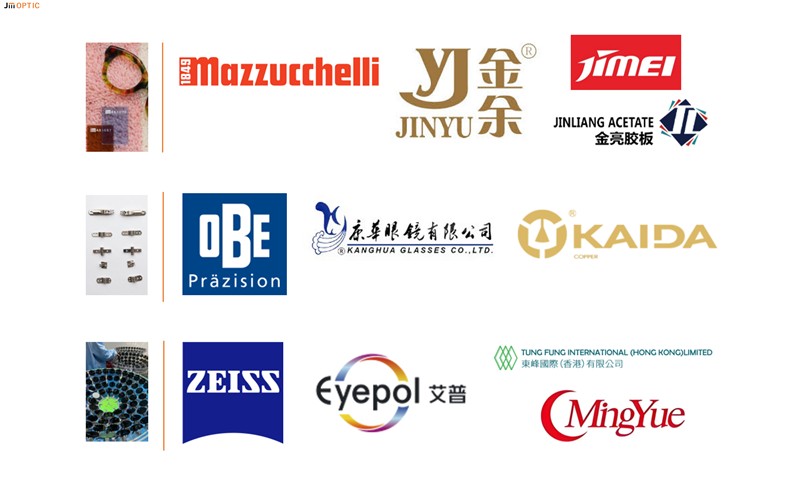
- Top-Tier Luxury: Mazzucchelli 1849 (Italy) is the gold standard for rich, deep patterns (like Havana or Tortoise).
- Premium Commercial: Jimei, Jinyu, ELEUNG all origin from China and offer excellent high-density acetate that rivals European suppliers at a better cost-efficiency.
- Eco-Friendly Trend (2026): Look for ISCC Certified Bio-Acetate (such as Mazzucchelli M49 or Jimei Bio-acetate). These materials contain over 60% plant-based fibers (cotton and wood pulp) and are phthalate-free, which is crucial for modern eco-conscious consumers.
Verifiable Data: At JM Optical, we provide valid Material Transaction Certificates (TC) for every batch of Bio-acetate to guarantee its authenticity for your custom acetate frames marketing claims.
Step 2: Evaluate the Manufacturing & Curing Process (Solving the "Warping" Problem)
The Problem: Many buyers complain that their wholesale acetate frames lose their shape or the lenses pop out during shipping. This happens because raw acetate contains moisture and solvents. If cut too quickly, the material shrinks later.
The JM Optical Solution: As an experienced custom acetate frames manufacturer, we employ a strict "Oven Aging Process".
- Curing: Before any CNC cutting, raw acetate slabs are baked in constant-temperature ovens at 60°C for 72 hours. This eliminates residual solvents and stabilizes the material.
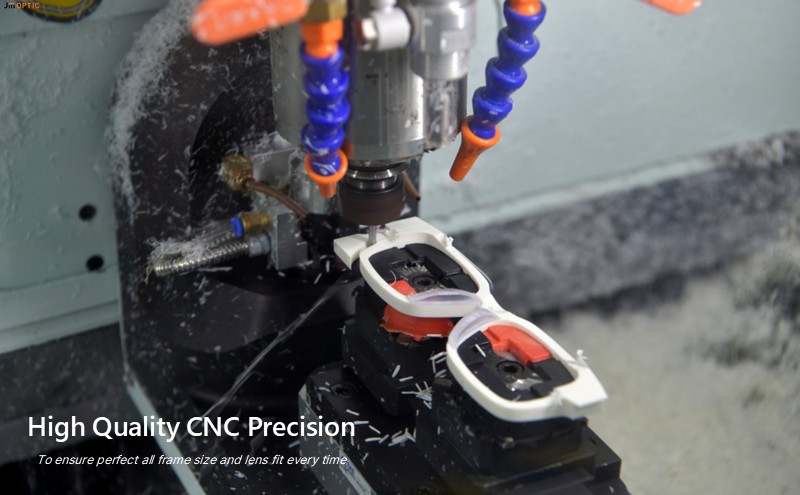
- CNC Precision: We use 5-Axis CNC milling machines to carve the front frames. Our dimensional tolerance is strictly controlled within ±0.05mm, ensuring a perfect lens fit every time.
- Post-CNC Thermal Stabilization (Secondary Curing):
This is the step most cheap factories skip. Machining acetate generates internal mechanical stress. If polished immediately after CNC cutting, the frame will eventually micro-warp. To prevent this, our semi-finished fronts are mounted onto specialized base-curve jigs and placed into a low-temperature thermostatic chamber (45°C - 50°C) for an additional 24 to 48 hours. This "annealing" process relieves all internal machining stress and permanently locks in the curvature of the bridge and lens grooves.
If your current acetate frames supplier skips the aging process to rush lead times, your brand will suffer from high customer return rates.
Step 3: Inspect the Hardware and Polishing (The Luxury Feel)
What separates a $20 frame from a $200 frame? The hardware and the surface gloss.
Hinge Engineering: The Universal Superiority of Pin-Through Riveted Hinges
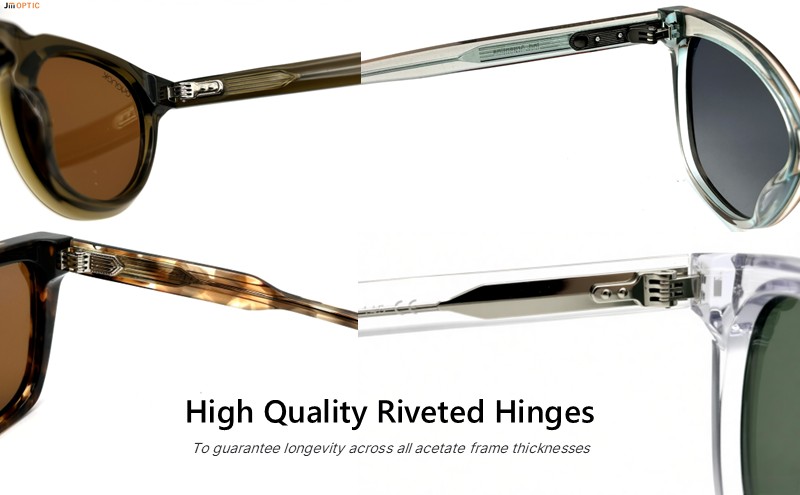
The temple joint is the most vulnerable stress point on any frame. Whether you are designing an elegant, standard-profile daily reader or a bold, chunky sunglass, hinge failure is the leading cause of customer returns. A standard heat-sunk hinge will eventually rip out of the plastic. To guarantee longevity across all frame thicknesses, your acetate frames manufacturer is better to use Pin-through Riveted Hinges (e.g., 5-barrel or 7-barrel hinges from OBE or Comotec).
- The Complex Machining Process:Unlike heat-sinking, riveting is a meticulous mechanical process. First, our 5-axis CNC machines drill precise, micro-millimeter holes completely through the acetate front and temples. Next, metal pins (rivets) are manually inserted through the acetate and the hinge base plate. Finally, a specialized peening machine presses and flattens the tips of the pins, creating a permanent, cold-forged mechanical interlock.
- Maximum Torque Resistance (The "Shallow Bite" Solution):Because the metal pins physically pass through the entire cross-section of the solid acetate slab, the hinge does not rely on friction or the depth of the plastic. This provides an unbreakable mechanical anchor, ensuring your acetate glasses can withstand extreme lateral pulling forces, regardless of whether the frame is 4mm or 10mm thick.
True Repairability for Opticians: From a sustainability and retail perspective, riveted frames are vastly superior. If a hinge is accidentally crushed, a professional optician at the dispensary can simply punch out the old pins and install a new hinge. Heat-sunk frames, once broken, go straight to the landfill.
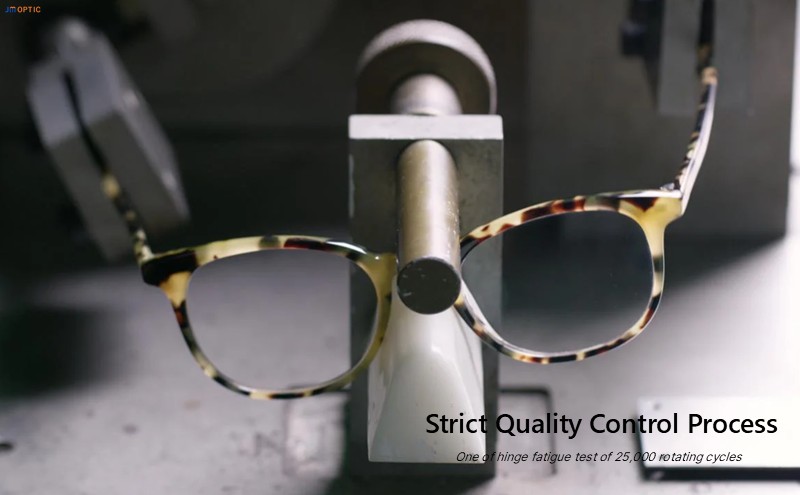
- Test Metric: Our riveted hinges undergo a fatigue test of 25,000 rotating cycles and can withstand over 30kg of pulling force.
The "Glass-Like" Polish
The Problem: Low-quality wholesale acetate eyewear often has dull edges or visible machine marks.
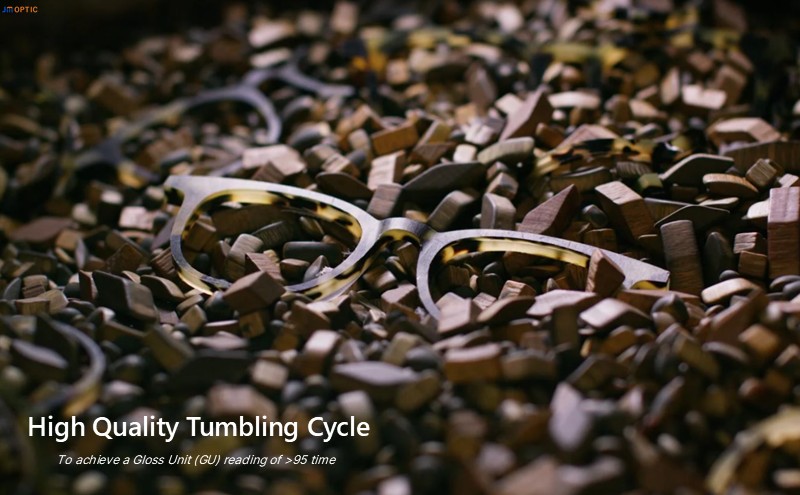
The Solution: Achieving a liquid-like gloss requires time. At JM Optical, our custom acetate frames undergo a rigorous 96-hour tumbling cycle using German wood pegs and organic polishing wax, followed by manual wheel-buffing. This achieves a Gloss Unit (GU) reading of >95.
Step 4: Ensure Global Market Compliance (Regional Service Proof)
A reliable custom acetate frames manufacturer doesn't just produce goods; they protect your business from customs delays and legal liabilities. Eyewear is classified as a medical device (or protective equipment) in many countries.
As a global exporter, Shanghai JM Optical provides complete regulatory support:
- For the USA Market: Our factory is FDA Registered. We ensure all demo lenses pass the FDA Drop Ball Test (21 CFR 801.410) for impact resistance. We strictly comply with California Proposition 65 (Lead < 90ppm).
- For the European Market (EU/UK): Our acetate optical frames are fully CE marked. We provide SGS laboratory test reports for REACH compliance, ensuring zero Nickel Release (EN 1811 standard) on all metal components like wire cores and hinges.
- Regional Logistics: We offer DDP (Delivered Duty Paid) shipping services to major hubs including Los Angeles, New York, London, and Frankfurt. We handle the complex HS code declarations so your wholesale acetate glasses arrive directly at your warehouse without customs headaches.
Conclusion: Partner with the Right Acetate Frames Manufacturer
Choosing the right custom acetate frames manufacturer is the most critical decision for your brand's success. You need a partner who understands dimensional stability, premium polishing, and global compliance.
With over 18 years of R&D and export experience, Shanghai JM Optical Co., Ltd. is ready to bring your design blueprints to life.
- Flexible MOQ: Starting from 300 pcs per model (mixable in 3 colors) for OEM/ODM or 12 pcs/col. for ready models.
- Branding Services: Custom logo, models shooting, and bespoke sizing (Petite to XL fit).
- Prototyping: 3D printing samples available in 7 to 14 days.
- Lead Time: 60-75 days for bulk production.
Stop risking your brand reputation with unverified suppliers. [Contact JM Optical Today] to request our 2026 catalog or get a free technical consultation for your next custom acetate frames project.
Email: jim@shjmoptical.com
Website: www.shjmoptical.com
WhatsApp: +86-137-6415-0962