
How to Find Right Eyewear Manufacturers from China (VII) Eyewear Quality Standards: CE, FDA, ISO — What Buyers Need to Know
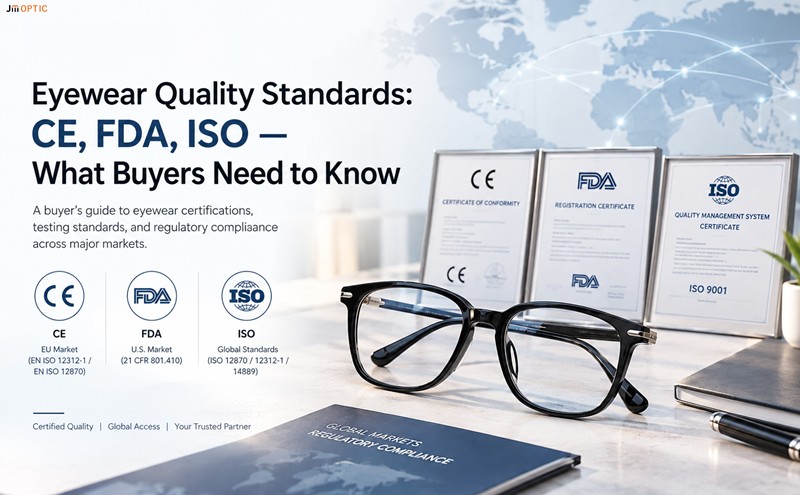
A buyer’s guide to eyewear certifications, testing standards, and regulatory compliance across major markets.
Quick answer: Eyewear CE, FDA, and ISO certifications are mandatory regulatory requirements for selling glasses in the EU, US, and international markets. CE marking (based on EN ISO 12312-1 for sunglasses and EN ISO 12870 for frames) is required for all eyewear sold in the European Economic Area. FDA registration (under 21 CFR 801.410) is mandatory for any eyewear entering the United States — including impact-resistant lens testing and establishment registration. ISO standards (ISO 12870, ISO 12312-1, ISO 14889) provide the underlying technical test methods and quality benchmarks that both CE and FDA compliance rely on. Together, eyewear CE FDA ISO certifications form a three-layer compliance framework that protects your brand from customs seizures, product recalls, and liability claims.
If you are sourcing eyewear from China for resale in Europe, North America, or other regulated markets, certification compliance is not optional — it is the gatekeeper to market entry. Products that lack proper eyewear CE FDA ISO documentation can be detained at customs, recalled by market surveillance authorities, or rejected by retail buyers. For a B2B importer, understanding the certification landscape is just as important as choosing the right frame style or material.
📌 This is Part 7 of our ongoing series: “How to Find Right Eyewear Manufacturers from China.” For context, see Part 1 (Manufacturing Hubs), Part 2 (Finding Suppliers), Part 3 (Evaluating Suppliers), Part 4 (OEM vs ODM vs OBM), Part 5 (MOQ, Pricing & Payment Terms), and Part 6 (Eyewear Frame Materials).
1. The Three Pillars of Eyewear Compliance
Eyewear is regulated as either a personal protective equipment (PPE) or a medical device in most major markets. The eyewear CE FDA ISO compliance framework rests on three pillars, each governing a different market and aspect of product safety:
1.1 CE Marking — The European Gateway
CE marking is a mandatory conformity assessment for products sold in the European Economic Area (EEA). For eyewear, the applicable regulations are the PPE Regulation (EU) 2016/425 for sunglasses and safety eyewear, and the Medical Device Regulation (MDR) 2017/745 for corrective lenses. CE marking confirms that a product meets EU safety, health, and environmental protection requirements. Without it, eyewear cannot be legally placed on the EU market — customs will seize non-compliant shipments at the border.
1.2 FDA Registration — The US Gateway
The US Food and Drug Administration (FDA) classifies eyewear — including sunglasses, spectacle frames, and prescription lenses — as Class I medical devices. While most eyewear products are exempt from 510(k) premarket notification, manufacturers and importers must still register their establishment, list their devices, comply with the Quality System Regulation (21 CFR Part 820), and ensure all lenses pass impact-resistance testing under 21 CFR 801.410. No eyewear CE FDA ISO compliance programme is complete without FDA registration for US-bound shipments.
1.3 ISO Standards — The International Benchmark
ISO standards provide the technical test methods and quality benchmarks that underpin both CE and FDA compliance. Key standards include ISO 12870 (eyewear frames), ISO 12312-1 (sunglasses), and ISO 14889 (uncut finished lenses). While ISO certification itself is not a legal market-access requirement, the EN ISO versions of these standards are cited as harmonised standards under EU regulations, and the test methods are referenced by FDA regulations. An eyewear CE FDA ISO strategy therefore uses ISO as the foundation, CE as the European layer, and FDA as the American layer.
2. CE Marking — The European Gateway in Detail
CE marking is the most complex of the eyewear CE FDA ISO certifications, involving multiple regulations, harmonized standards, and a documented conformity assessment process. Here is what eyewear buyers need to understand.
2.1 Applicable EU Regulations
Eyewear falls under one of two EU regulatory frameworks, depending on its intended use:
- PPE Regulation (EU) 2016/425 — governs sunglasses, fashion spectacles with UV protection, and safety eyewear. Sunglasses for general use are classified as PPE Category I (simple design, self-declaration). Protective eyewear (sports, industrial) may be Category II or III, requiring notified body involvement.
- Medical Device Regulation (MDR) 2017/745 — governs corrective/prescription eyewear (spectacle frames with corrective lenses, reading glasses). These are typically Class I (non-sterile, non-measuring), allowing manufacturer self-declaration without notified body audit.
2.2 Key EN ISO Standards for CE Compliance
CE compliance for eyewear is demonstrated through testing against the following harmonised European standards:
- EN ISO 12312-1:2022 — Sunglasses and fashion spectacles. Replaces the older EN 1836 standard. Tests UV filtration (UVA/UVB transmittance ≤1%), light transmittance categories (0–4), optical quality (spherical power, astigmatic power, prismatic power), impact resistance, and lens retention.
- EN ISO 12870 — Spectacle frames. Tests frame dimensions, dimensional stability, nose-bridge deformation, temple endurance (500 open/close cycles), resistance to perspiration (artificial sweat), resistance to ignition, and nickel release levels.
- EN ISO 16034 / EN 14139 — Single-vision ready-to-wear reading glasses. Tests optical power accuracy, prismatic deviation, and mechanical durability.
- EN 166 / EN ISO 16321-1 — Personal eye protectors (safety eyewear). Tests impact resistance at higher energy levels, optical clarity, field of coverage, and resistance to chemical splashes.
2.3 The CE Certification Process
The CE marking process for eyewear follows these steps:
- Step 1 — Product classification: Determine whether your product is PPE or a medical device, and its risk category. This determines the conformity assessment module.
- Step 2 — Laboratory testing: Send samples to an ISO 17025-accredited laboratory for testing against the relevant EN ISO standards. The lab issues a test report covering optical, mechanical, and chemical properties.
- Step 3 — Technical documentation (TCF): Compile a technical construction file including product description, design drawings, BOM (bill of materials), test reports, risk assessment, user instructions, and labelling artwork.
- Step 4 — Declaration of Conformity (DoC): The manufacturer (or EU authorised representative) signs the EU Declaration of Conformity, formally declaring compliance with all applicable directives.
- Step 5 — CE mark affixing: Apply the CE mark to the product (temple arm or frame), packaging, and accompanying documents. For PPE Category II/III, the notified body’s 4-digit identification number must accompany the CE mark.
2.4 CE Certification Timeline and Cost
For standard sunglasses and optical frames (PPE Category I or MDR Class I), the process typically takes 4–8 weeks, including sample testing and document preparation. Costs range from US$800–2,500 per product category, depending on the number of test items and whether a notified body is required. For eyewear CE FDA ISO compliance, the CE component is usually the most time-consuming and expensive part of the certification package.
- Self-declaration (PPE Category I / MDR Class I): No notified body required; manufacturer conducts testing and signs DoC. Lower cost, faster timeline.
- Notified body route (PPE Category II/III): Requires EU-Type Examination (Module B) by an accredited body such as TÜV, SGS, or Intertek. Higher cost, longer timeline (8–12 weeks).
3. FDA Registration — Entering the US Market
The FDA regulates eyewear as medical devices under Title 21 of the Code of Federal Regulations. Understanding the FDA layer of the eyewear CE FDA ISO framework is essential for any buyer importing into the United States.
3.1 FDA Classification of Eyewear
All eyewear products sold in the US are classified as Class I medical devices:
- Sunglasses (non-prescription) — 21 CFR 886.5850, product code HQY. Exempt from 510(k) premarket notification since 1998.
- Spectacle frames — 21 CFR 886.5842, product code HQZ. Also 510(k) exempt.
- Prescription spectacle lenses — 21 CFR 886.5844, product code HQG. Also 510(k) exempt.
- Reading glasses (magnifying spectacles) — 21 CFR 886.5840, product code HOI. Also 510(k) exempt.
Although 510(k) exempt, all these devices still require establishment registration, device listing, quality system compliance, and impact-resistance testing.
3.2 Establishment Registration and Device Listing
Foreign manufacturers (including Chinese eyewear factories) must:
- Register their manufacturing facility with the FDA and obtain an FEI (Facility Establishment Identifier) number.
- Designate a US Agent — a person or entity residing in the US that serves as the FDA’s contact point for the foreign manufacturer. This is mandatory under 21 CFR 807.40.
- List each device category manufactured, using the appropriate product codes (HQY, HQZ, HQG, HOI).
- Renew registration annually (between October 1 and December 31 each year). Failure to renew results in automatic cancellation.
3.3 Impact Resistance Testing — The Drop Ball Test
Under 21 CFR 801.410, all lenses in eyeglasses and sunglasses sold in the US must be impact-resistant. The standard test method is the drop ball test:
- A 5/8-inch (15.9mm) steel ball weighing approximately 0.56 ounces (16g) is dropped from a height of 50 inches (127cm) onto the horizontal upper surface of the lens.
- The ball must strike within a 5/8-inch diameter circle at the geometric centre of the lens.
- To pass, the lens must not fracture, crack, or chip. Any visible damage constitutes failure.
- Glass prescription lenses must be individually tested; plastic lenses may be tested on a statistical sampling basis (AQL 6.5, General Inspection Level II).
A Certificate of Impact Resistance must accompany each shipment of eyewear entering the US. This document, issued by the manufacturer, confirms that the lenses have been tested and meet the requirements of 21 CFR 801.410. Without this certificate, shipments may be detained under FDA Import Alert #86-07 and subject to Detention Without Physical Examination (DWPE). This is one of the most common reasons for eyewear CE FDA ISO compliance failures at US ports.
3.4 Quality System Regulation (21 CFR Part 820)
Eyewear manufacturers must implement a Quality Management System compliant with 21 CFR Part 820. This covers design controls, purchasing controls, production and process controls, acceptance activities, CAPA (corrective and preventive actions), labelling, and records management. Many factories achieve this through ISO 13485 certification, which aligns with FDA QSR requirements and is recognized as an equivalent quality system. This is one reason why eyewear CE FDA ISO compliance is treated as an integrated package — the ISO quality system underpins both CE and FDA requirements.
4. ISO Standards — The International Benchmark
ISO standards form the technical foundation of the eyewear CE FDA ISO compliance framework. They define the test methods, performance criteria, and quality benchmarks that CE marking and FDA registration rely upon. Understanding which ISO standards apply to your products is essential for verifying supplier compliance and ensuring product consistency.
4.1 Key ISO Standards for Eyewear
ISO Standard | Scope | Key Test Items |
ISO 12870 | Spectacle frames | Frame dimensions, dimensional stability, nose-bridge deformation, temple endurance, resistance to perspiration, resistance to ignition, nickel release |
ISO 12312-1 | Sunglasses & fashion eyewear | UV filtration (UVA/UVB ≤1%), transmittance categories 0–4, optical quality, impact resistance, lens retention, labelling |
ISO 14889 | Uncut finished lenses | Fundamental requirements for uncut spectacle lenses: optical properties, mechanical strength, transmittance |
ISO 8980 series | Spectacle lenses | Single-vision (Part 1), multifocal (Part 2), progressive (Part 3), transmittance (Part 4), minimum requirements (Part 5) |
ISO 16034 | Ready-to-wear reading glasses | Optical power accuracy, prismatic deviation, mechanical durability, labelling |
ISO 13485 | Medical device QMS | Quality management system for medical devices; aligns with FDA QSR (21 CFR 820) |
ISO 10993 | Biological evaluation | Biocompatibility testing for materials in contact with skin; relevant for hypoallergenic claims |
ISO 14971 | Risk management | Risk analysis and management for medical devices; required under MDR for corrective eyewear |
4.2 ISO vs National Standards — Understanding the Relationship
The EN ISO versions (e.g., EN ISO 12312-1) are the European adoption of the international ISO standard, sometimes with minor modifications. In the US, ANSI Z80.3 (sunglasses), ANSI Z80.5 (frames), and ANSI Z80.31 (reading glasses) are the national equivalents. In China, the domestic standards GB 39552.1 (sunglasses) and GB/T 14214 (frames) align closely with their ISO counterparts but may have additional requirements. For eyewear CE FDA ISO compliance, testing against the EN ISO version is the most widely accepted approach, as it satisfies both EU CE requirements and is broadly compatible with FDA expectations.
4.3 Why ISO Compliance Matters Even When Not Mandatory
Even when a specific market does not legally require ISO certification, testing to ISO standards provides three benefits: (1) it demonstrates product quality to buyers and retailers who increasingly demand ISO test reports as a procurement condition; (2) it provides a documented defence against product liability claims if a customer is injured; (3) it streamlines future market expansion — if you later decide to enter the EU or US market, your ISO test reports can be reused for CE marking and FDA registration. This is why experienced eyewear buyers treat ISO testing as an investment, not an expense, within their eyewear CE FDA ISO compliance budget.
5. REACH and Chemical Compliance
Beyond CE, FDA, and ISO, chemical compliance is a critical and frequently overlooked dimension of the eyewear CE FDA ISO framework. The EU REACH Regulation (EC No 1907/2006) restricts certain chemicals in consumer products, including eyewear.
5.1 Nickel Release — The Most Common Failure Point
Nickel is the single most common compliance failure for eyewear. REACH Annex XVII, Entry 27 limits nickel release from metal components in prolonged skin contact to 0.5 µg/cm²/week. The test method is specified in EN 16128:2025 (updated October 2025, replacing EN 16128:2015), which defines a two-step process:
- Coating test: A dimethylglyoxime (DMG) test paper is applied to metal frame components to check for nickel presence through the surface coating. A pass on the coating test allows the product to be labelled REACH-compliant without further testing.
- Migration test: If the coating test fails, all metal parts of the sample must undergo the migration test — a simulated wear-and-corrosion procedure (EN 12472) followed by an artificial sweat immersion test. The nickel release rate is measured and compared against the 0.5 µg/cm²/week limit.
EN 16128:2025 will become the national standard in all EU member states by April 2026. The updated version introduces stricter sample preparation requirements, mandatory photographic records in test reports, and new quality control samples. Buyers sourcing metal eyewear frames should confirm their factory tests to the latest version.
5.2 Other REACH Restricted Substances in Eyewear
In addition to nickel, REACH restricts several substances commonly found in eyewear:
- Phthalates (DEHP, DBP, BBP, DINP, DIDP) — restricted in plasticised materials; relevant for TR90 frames, PVC temple tips, and cable temples.
- Lead and lead compounds — restricted under REACH Annex XVII Entry 63; also restricted under US CPSIA for children’s products (≤100 ppm total lead).
- Bisphenol A (BPA) — increasingly restricted in consumer products; relevant for polycarbonate lenses and some coatings.
- Heavy metals (cadmium, hexavalent chromium) — restricted under REACH Annex XVII; tested via ICP-MS or similar analytical methods.
5.3 CPSIA and California Proposition 65
For the US market, the Consumer Product Safety Improvement Act (CPSIA) imposes strict limits on lead (≤100 ppm) and phthalates (≤0.1% of each of six specified phthalates) in children’s products, including children’s sunglasses and reading glasses. California Proposition 65 requires warning labels for products containing chemicals known to the state of California to cause cancer or reproductive harm — a list that includes nickel, lead, and BPA. Both CPSIA and Prop 65 are commonly requested alongside FDA documentation as part of a comprehensive eyewear CE FDA ISO compliance package.
6. Certification Comparison Table
The table below summarizes the key differences between the three eyewear CE FDA ISO certifications and the related chemical compliance requirements:
Factor | CE Marking | FDA Registration | ISO Standards | REACH |
Market | European Economic Area | United States | International (voluntary) | European Economic Area |
Legal requirement | Mandatory | Mandatory | Voluntary (referenced by CE/FDA) | Mandatory (for EU) |
Key regulation | PPE Reg. 2016/425; MDR 2017/745 | 21 CFR 801.410; 21 CFR 820 | ISO 12870; ISO 12312-1; etc. | REACH (EC) 1907/2006 |
Key test | EN ISO 12312-1 / 12870 | Drop ball test (impact) | Various per standard | EN 16128:2025 (nickel) |
Typical timeline | 4–8 weeks | 2–6 weeks (registration) | 2–4 weeks (testing) | 1–2 weeks (per test) |
Renewal | Not required (valid if standards unchanged) | Annual (Oct 1–Dec 31) | Not required | Not required (test report valid) |
Who issues | Manufacturer (+ Notified Body for Cat II/III) | FDA (self-registration via FURLS) | ISO 17025-accredited lab | ISO 17025-accredited lab |
Indicative cost | US$800–2,500 | US$500–1,500/yr | US$200–800/test | US$150–500/test |
7. FAQ
Q: Do I need eyewear CE FDA ISO certifications for every single model I import?
A: CE marking is required for each product family (frame + lens combination) sold in the EU. FDA registration covers the manufacturing facility, not individual products — but each product category must be listed, and impact resistance testing applies per lens type. ISO test reports are per-product. Plan for testing each distinct model, but labs often offer reduced fees for variant testing (e.g., same frame in different colors).
Q: How long does the full eyewear CE FDA ISO certification process take?
A: For a new product line, expect 6–10 weeks total. CE testing and documentation typically take 4–8 weeks. FDA establishment registration takes 1–2 weeks (once the US Agent is appointed). ISO/REACH testing runs in parallel with CE testing. If a notified body is required (PPE Category II/III), add 4–6 weeks to the CE timeline.
Q: Can my Chinese factory handle the entire certification process?
A: Yes, most established eyewear factories in China can arrange eyewear CE FDA ISO testing through partner laboratories (SGS, TÜV, Intertek, BV). However, as the importer or brand owner, you are ultimately responsible for compliance in your market. Always review the test reports yourself, verify the lab’s accreditation, and retain copies of all documentation for your records. If you are the EU importer without an EC Rep appointed by the factory, you may bear legal manufacturer responsibility.
Q: What happens if my eyewear is detained at customs for non-compliance?
A: In the EU, non-CE-compliant products are refused entry and may be destroyed or returned at your expense. In the US, the FDA may issue a Detention Without Physical Examination (DWPE) under Import Alert #86-07, requiring you to provide certification of impact resistance before release. Repeated violations can result in your supplier being added to the FDA Red List, effectively banning all future shipments from that facility.
Q: Are reading glasses subject to the same certifications as sunglasses?
A: Reading glasses are classified as medical devices in both the EU (MDR Class I) and US (FDA Class I, product code HOI). They require CE marking (EN ISO 16034 / EN 14139), FDA establishment registration and device listing, and impact-resistant lenses. The UV protection requirements of EN ISO 12312-1 do not apply unless the reading glasses also function as sunglasses. However, the eyewear CE FDA ISO framework still applies — only the specific standards differ.
Q: How much should I budget for certifications per product line?
A: For a standard optical frame or sunglass line entering both EU and US markets, budget approximately US$3,000–8,000 for the initial certification package (CE testing + FDA registration + ISO test reports + REACH/EN 16128 testing). Annual FDA renewal costs US$1500–5000. New color/material variants may require additional testing at US$200–500 per test. These costs should be factored into your product pricing alongside the factory FOB price.
8. About JM Optical
JM Optical (Shanghai JM Optical Co., Ltd.) is a manufacturer and exporter of optical frames, sunglasses, reading glasses, and blue-light-blocking eyewear. Our products are manufactured at our Wenzhou factory, with design and development based in Shanghai.
We maintain full eyewear CE FDA ISO compliance documentation for our products. Our Wenzhou factory holds FDA establishment registration (renewed annually), and we work with accredited laboratories (SGS, TÜV, Intertek) for CE testing against EN ISO 12312-1, EN ISO 12870, and EN 16128:2025. We provide buyers with complete certification packages — including test reports, Declarations of Conformity, and Certificates of Impact Resistance — as part of our standard export documentation.
We supply wholesale buyers, private-label brands, and distributors across Europe, the Americas, and the Middle East, and are familiar with the certification requirements specific to each market.
MOQ: 12 pairs/color (ready stock) | 300 pairs/style · 100 pairs/color (OEM/ODM custom production)
Lead time: 7 days (ready goods) | 60–90 days (OEM/ODM)
Email: jim@shjmoptical.com | WhatsApp: +86-137-6415-0962 | shjmoptical.com