
How Do You Build a Private-Label Eyewear Brand Beyond the Logo?
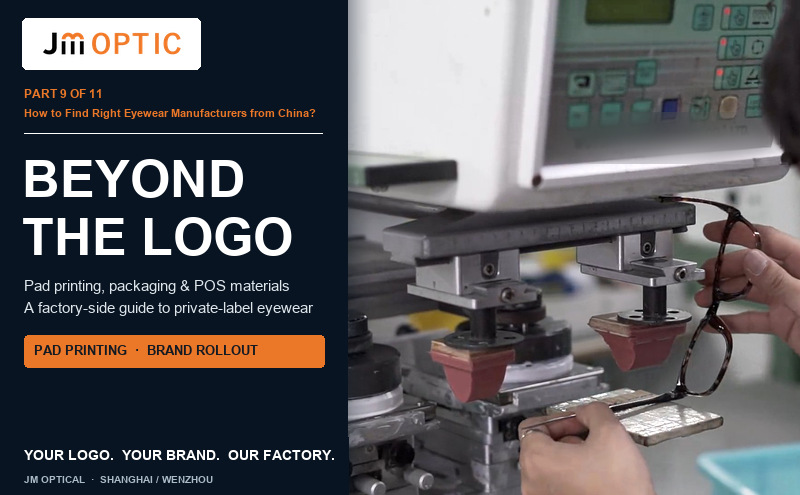
PART 9 OF 11 · How to Find Right Eyewear Manufacturers from China?
From pad printing on the temple to packaging, POS kits and channel materials — a factory-side guide by JM Optical (Shanghai JM Optical Co., Ltd.).
Quick answer: Pad printing transfers ink from a photochemically etched steel plate onto a curved temple with a soft silicone pad — it needs vector artwork, a Pantone reference and an approved strike-off (7–14 days). But a private-label brand is more than a printed logo. At JM Optical the full rollout also covers a visual identity system, custom-printed cases and boxes (300–500 unit print run), and POS / channel materials, all inside a 300 pcs per style OEM order with 60–90 days of production after sample approval. Ready stock with a simple printed logo starts at 12 pcs per colour in 7 days.
Most first-time buyers brief a factory on one thing: the logo. Send the artwork, approve a sample, ship. Six weeks later the frames arrive in a plain polybag, the case is unbranded, the retailer has no display card, and the range looks like everyone else’s — despite a perfectly printed temple.
A logo is one touchpoint. A brand is the set of decisions a customer meets before, during and after the frame: the signature acetate colour, the box, the pouch, the microfiber cloth, the hang tag, the counter stand, the e-commerce images, the insert card in their language. This guide covers both halves of that job from the factory side — how pad printing actually runs on our Wenzhou line, and what we build around the print so your range arrives shelf-ready.
If you are still choosing between printing methods — pad printing, silk screen, laser engraving, metal plaques — start with our guide to custom logo options for eyewear. Part 9 picks up where that comparison ends: one process in depth, then the brand system built on top of it.
📌 This is Part 9 of our 11-part series “How to Find Right Eyewear Manufacturers from China.” For the commercial numbers see Part 5 (MOQ, pricing & payment terms), for material choice Part 6 (frame materials), for compliance Part 7 (CE, FDA & ISO), and for approvals Part 8 (sampling & testing). Part 10 covers shipping and lead times.
1. Why the logo is only the first 10% of a brand
A printed temple marking is the easiest part of private label to specify and the easiest to copy. It is also the part a customer sees least: when the frames are worn, the outside temple is the only visible surface, and on many styles it is hidden by hair or by the arm of a sofa. What a buyer actually notices happens earlier and later — the box on the shelf, the case in the bag, the card explaining the fit, the way the range is photographed.
Treat branding as a small system with four layers: (1) the mark on the frame, (2) the material and colour that make the frame recognisable without the mark, (3) the packaging that carries the mark into the customer’s home, and (4) the channel materials that let a retailer sell it. Layers 2–4 are specified before production, not after shipment. Once a bulk order is packed in unbranded cases, adding branding means re-packing every unit by hand.
2. Pad printing on the temple — the process, step by step
Pad printing is the workhorse of eyewear branding because a soft silicone pad can lay ink onto a curved, narrow or irregular surface that a flat screen cannot reach. It is used for the brand logo, the model and colour code, size markings and the CE / UKCA mark. Most logos are one or two colours; each extra colour means another plate and another pass through the machine.
| Step | What happens on the line | What it decides |
|---|---|---|
| 1. Etched plate | Artwork is photochemically etched into a thin steel plate; the pattern sits below the surface. | Line sharpness and the smallest legible text. |
| 2. Ink fill & doctor blade | Ink is flooded over the plate and a blade wipes the surface, leaving ink only in the grooves. | Colour accuracy (Pantone) and opacity on dark acetate. |
| 3. Silicone pad pickup | A soft silicone pad presses onto the plate and lifts the ink film. | How well the print wraps around a curved temple. |
| 4. Transfer & cure | The pad presses the ink onto the temple; parts air-dry or low-bake. | Adhesion, rub resistance and when packing can start. |
Two details decide whether the print survives retail. First, cure time: 5–10 minutes is only touch-dry, 24 hours is handling-safe, and 48 hours is fully cured and resistant to scratching and alcohol. Second, the substrate: TR90 and PC cannot take high heat, so we use cold-air fan drying or a quick-dry thinner at ≤50 °C; metal and titanium temples tolerate a 40–50 °C low-temperature bake for 20–25 minutes. A rushed cure is the most common cause of a logo that looks perfect on day one and rubs off in a shop window.
🎥 Watch it on our line (17 seconds): Pad Printing on Eyewear Frame Temple — JM Optical factory
Full URL: https://www.youtube.com/watch?v=X1cibAvOvBY
The clip shows the etched plate, the silicone pad and the transfer at our Wenzhou factory. Printing is done in-house, not outsourced — which is why the logo, the model number and the CE mark can be applied in the same fixture and checked against the same approved sample. For a brand owner, that means one accountable party for the frame, the marking and the packing.
3. What the factory needs from you
Most first-sample rejections come from an incomplete brief, not from a bad printer. Freeze these five items before asking for a strike-off:
| Item | What to send | Why it matters |
|---|---|---|
| Artwork | Vector file (AI, PDF or SVG), fonts outlined | A raster logo blurred at 8 mm cannot be sharpened on the plate. |
| Colour | Pantone or CMYK reference | White, grey, gold and silver are the usual temple-printing colours. |
| Placement & size | Outer / inner temple, front corner, lens corner; size in mm | Sets the fixture and the plate; e.g. 8 mm on the outer temple. |
| Passes | Number of colours / print passes | Each extra colour adds a plate and a pass. |
| Approval | Sign-off on a strike-off on the actual frame colour | The approved sample becomes the bulk QC standard. |
If your logo is a detailed full-colour mark, ask for a simplified one-colour version. A busy logo printed small on a temple reads as a smudge — this is a design decision, not a printing defect.
4. How the print is checked before bulk
A print that passes a visual check can still fail in a retail window. On the pre-production sample we ask for a rub / abrasion test and a tape adhesion check; for plated or inlaid metal parts, a salt-spray report; and for TR90, confirmation of plasma or corona pre-treatment, because low surface energy is the usual cause of peeling. Printed parts are held for the full 48-hour cure before packing. These three checks are the failure points we see most often, and they cost a few days at sampling rather than a returns problem after shipment.
5. Visual identity — being recognised without the logo
The strongest private-label eyewear ranges are recognisable from two metres away, before anyone reads a temple. That comes from the material, not the marking: a signature acetate colour, a custom tortoise, a two-layer lamination, or a consistent metal finish across the whole family.
We match against your physical sample, a colour chip or a Pantone reference, and the approved sample becomes the bulk standard for every reorder. Italian sheet brands can be specified if your market expects them. Lock one signature colour across three or four styles and it usually falls within the same MOQ band as stock colours — which makes it one of the cheapest brand moves available to a small buyer. Ask for the colour standard to be recorded in writing, or reorders twelve months later will drift.
6. Packaging that carries the brand
Packaging is where a logo becomes an experience, and it is the layer most often left until the frames are already in production. Each printed element has its own print-run minimum, so it has to be ordered in parallel.
| Element | Typical method | Print-run minimum | Ordered when |
|---|---|---|---|
| Hard case | Hot stamping or pad print | 300–500 units | At artwork freeze, parallel with frames |
| Microfiber pouch & cloth | Screen print or embossing | 300–500 units | Parallel with frames |
| Gift box & sleeve | Offset / UV print, dieline supplied | 300–500 units | Parallel with frames |
| Manual, warranty & insert card | Offset, market-language versions | 300–500 units | After artwork freeze |
| Hang tag & barcode label | Digital or offset | 300–500 units | Before final packing |
Send one dieline and one artwork master for all five; re-drawing a logo separately for the case, the box and the cloth is how colour drift and misalignment appear. If 300–500 units is beyond your first order, start with a branded cloth and hang tag on a stock case, then move to a printed box at the second reorder.
7. Channel & POS materials
A retailer cannot sell what they cannot explain. The channel kit is specified at the same artwork freeze as the packaging:
- Display — counter display stand or tray sized to the range, and a shelf talker with the collection name
- Retail — price tag, hang tag and a sell-in sheet with sizes (e.g. 60□17-145), material, MOQ and lead time
- E-commerce — white-background 360° images and a consistent set of lifestyle shots for the same SKU
- After-sale — insert card, warranty terms and compliance markings in the destination-market language
- Sequence — the unboxing order — case, pouch, cloth, card — so the brand reads the same in every market
These items are cheap relative to a frame order but slow to re-do once a shipment has left. They belong in the same brief as the logo.
8. Brand rollout — MOQ and timeline
The numbers below are the same working ranges we use across our product pages and the rest of this series. Packaging runs in parallel with frames; it does not add days to the critical path if it is ordered at artwork freeze.
| Stage | Minimum | Lead time | Notes |
|---|---|---|---|
| Ready stock + simple printed logo | 12 pcs / colour | 7 days | No tooling; mix colours freely |
| Logo strike-off on an existing style | US$30–300 per style | 7–14 days | Fee usually credited against a bulk order |
| New plaque / tooling / development sample | Per style | 30–75 days | CAD, tooling, hand sample, revisions |
| Custom OEM with logo + branded packaging | 300 pcs / style, ≥100 pcs / colour | 60–90 days after sample approval | Your shape, colour, logo and packaging |
| Injection-moulded TR90 / PC | 600 pcs / style, ≥200 pcs / colour | 60–90 days | Mould cost applies |
| Printed packaging run | 300–500 units | Runs in parallel | Order at artwork freeze |
9. Frequently asked questions
Q: How is pad printing different from silk screen and laser engraving on a temple?
A: Pad printing uses a soft silicone pad to transfer ink from an etched plate, so it works on curved and narrow surfaces and on small text. Silk screen pushes ink through a mesh and suits larger flat areas. Laser engraving removes material and is permanent, but cannot produce colour. For a method-by-method comparison including hot stamping, metal plaques and inlay, see our custom logo options guide linked above.
Q: Can a small brand get branded packaging without a 300-piece commitment?
A: Not on a custom print run: 300–500 units is the practical minimum for a printed case, box or insert because the plate and setup costs are fixed. The low-volume route is a stock case plus a branded microfiber cloth and hang tag, or ready-stock frames with a simple printed logo from 12 pcs per colour. Move to fully printed packaging at the second reorder.
Q: What exactly is included in a private-label eyewear rollout beyond the frame?
A: A visual identity standard (signature colour and logo usage), printed or embossed case, pouch, cloth, gift box, manual and insert card, hang tag and barcode label, plus the channel kit — display stand, shelf talker, sell-in sheet and a consistent set of e-commerce images. All of it is frozen before mass production.
Q: How do you keep a signature acetate colour consistent across reorders?
A: We match against a physical sample, colour chip or Pantone reference, produce an approved sample, and record that sample as the bulk standard. Insist on a written colour standard: acetate lots vary, and a reorder placed a year later without a retained sample is the most common source of visible drift.
Q: How long from artwork approval to shelf-ready stock?
A: 7–14 days for a strike-off on an existing style, then 60–90 days of mass production after sample approval, with the 300–500 unit packaging run happening in parallel. If new tooling or a bespoke plaque is needed, add 30–75 days for the development sample. Ready stock with a simple printed logo ships in 7 days.
10. About JM Optical
JM Optical (Shanghai JM Optical Co., Ltd.) is a China-based eyewear manufacturer and exporter with nearly 20 years of experience. Design and development are based in Shanghai; production runs at our Wenzhou factory, making acetate optical frames, metal and titanium frames, sunglasses, reading glasses, blue-light-blocking eyewear and AI smart glasses for B2B buyers across Europe, the Americas and the Middle East. We hold an ISO 9001 quality system, and CE / FCC test documentation is available for applicable models. Logo printing, engraving and branded packaging are handled in-house on the same line as frame assembly.
MOQ: 12 pcs per colour (ready stock) | 300 pcs per style (OEM/ODM)
Lead time: 7 days (ready stock) | 60–90 days (OEM, after sample approval)
Contact: jim@shjmoptical.com | WhatsApp +86-137-6415-0962 | https://shjmoptical.com/
Related reading from the same series: Part 5 — MOQ, pricing & payment terms · Part 6 — frame materials · Part 7 — CE, FDA & ISO · Part 8 — sampling & testing · custom logo options compared
← Part 8: How to Sample & Test Eyewear Before a Bulk Order
https://shjmoptical.com/eyewear-sampling-testing-guide/
→ Part 10: Shipping & Lead Times — Coming soon (not yet published)
© JM Optical 2026 · Designed in Shanghai, manufactured in Wenzhou