
How Long Does an Eyewear OEM Order Take from Sampling to Mass Production?
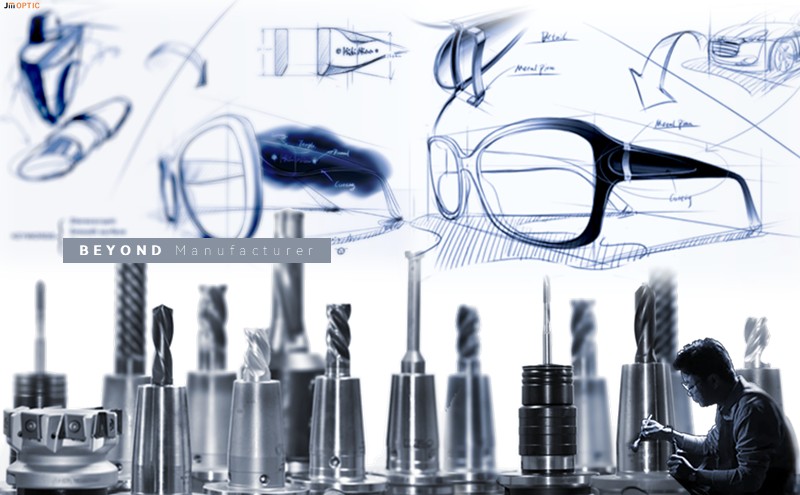
HOW TO FIND RIGHT EYEWEAR MANUFACTURERS FROM CHINA? · BUYER GUIDE
A practical B2B sourcing guide by JM Optical (Shanghai JM Optical Co., Ltd.).
Quick answer: An eyewear OEM order runs on four separate clocks at JM Optical: 7 days to dispatch ready stock, 7–14 days for a sample of an existing style, 30–75 days for a new development sample with tooling, and 60–90 days of mass production counted only after the approved sample is signed off. Custom OEM starts at 300 pcs per style (≥100 pcs per colour); ready stock starts at 12 pcs per colour.
📌 This guide complements our 11-part series “How to Find Right Eyewear Manufacturers from China?” and is the single reference for lead times across it. For commercial numbers see Part 5 (MOQ, pricing & payment terms), for the sample procedure Part 8 (sampling & testing), for material choice Part 6 (frame materials), for compliance Part 7 (CE, FDA & ISO), and for branding Part 9 (pad printing & brand rollout).
1. Lead Time at a Glance — JM Optical
| Order type | What happens | Time | Minimum |
|---|---|---|---|
| Ready stock, existing colours | Pick, inspect, pack, ship | 7 days | 12 pcs / colour |
| Sample, existing style + your logo | Vector artwork, strike-off, print, QC | 7–14 days | 1 sample |
| Sample, new development | CAD, tooling, hand sample, revisions | 30–75 days | 1 sample + tooling |
| OEM mass production, acetate / metal | Material prep, CNC, tumbling, assembly, QC | 60–90 days after sample approval | 300 pcs / style, ≥100 pcs / colour |
| OEM mass production, injection (TR90 / PC) | Mould, injection, finishing, QC | 60–90 days | 600 pcs / style, ≥200 pcs / colour |
| Custom packaging | Print run for case, box, pouch and cloth | Runs in parallel with frames | 300–500 units |
These are our own factory numbers, not industry averages. The same figures appear on every JM Optical product specification block. Prices are quoted per order, not published, because they depend on material, lens, decoration and quantity.
2. The Four Clocks Buyers Mix Up
Most sourcing disputes come from treating “lead time” as one number. It is not. 7 days is dispatch of frames that already exist. 7–14 days is a sample of an existing style with your logo; 30–75 days is a development sample that needs CAD, a new mould or a custom acetate lamination. 60–90 days is mass production, and that clock starts on the day you sign off the approved sample — not on the day you send an enquiry. Arguing about “60 days” before sample approval is meaningless.
Samples are normally paid 100% upfront and the fee is credited against the first bulk order. Courier is DHL / FedEx / UPS. Production starts only after the signed-off sample, a Pantone or physical colour reference and the logo artwork are all frozen.
3. What Actually Happens Inside the 60–90 Days
| Stage | Typical duration | What can slip |
|---|---|---|
| Material sourcing & colour approval | 7–14 days | Bespoke acetate lamination, Pantone mismatch on first strike-off |
| Front cutting / CNC / moulding | 10–20 days | A new injection mould adds 30–75 days before this stage |
| Tumbling & polishing | 3–6 days | Premium acetate needs 3–4 cycles and 96+ hours |
| Assembly, hinges, logo application | 7–14 days | Bespoke metal plaque, pad-printing strike-off approval |
| Lens cutting & fitting | 5–10 days | Polarised, photochromic or prescription lens supply |
| QC, test reports, packing | 5–10 days | CE / FDA drop-ball / ISO 12870 documentation for the destination market |
On the shop floor an acetate frame is cut from an aged sheet, tumbled in polishing barrels and hand-finished; a metal frame is stamped, welded, polished and plated. Because the same line also builds sunglasses and optical frames in one production run, a mixed order does not add a second clock — it only adds the lens step.
4. Six Things That Add Weeks
- New tooling. A bespoke front shape or injection mould adds a 30–75 day development sample before mass production can be scheduled.
- Custom materials. A bespoke acetate lamination, a titanium grade or a special plating needs a separate material lead time.
- Certification testing. CE, FDA drop-ball, ISO 12870 and EN 1811 nickel release reports are booked against a lab calendar, not ours.
- Custom packaging. Printed cases, boxes, pouches and cloths carry a 300–500 unit print-run minimum and their own proof cycle.
- Peak season. December to February and the run-up to SILMO / Vision Expo compress finishing and QC capacity.
- Slow approvals. Every day a strike-off or colour standard sits in a buyer’s inbox moves the production start date.
5. How to Shorten the Timeline Without Paying More
- Accept an existing shape and change only the logo or colour — you stay on the 7–14 day sample path instead of the 30–75 day development path.
- Approve colour from a physical swatch under D65 lighting, not a screen image; one rejected strike-off costs a full cycle.
- Freeze vector artwork and the Pantone reference before sampling starts. See which logo methods need no extra tooling.
- Bundle categories: order sunglasses and optical frames together so one factory, one MOQ and one QC protocol cover both.
- Book test reports and packaging proofs in parallel with frame production, not after it.
If you genuinely need frames in under three weeks, the honest answer is ready stock: 12 pcs per colour, shipped in 7 days, with a simple printed logo. Custom OEM cannot be compressed into 30 days without dropping a process step — and the step that gets dropped is usually the one you would have inspected.
6. FAQ
Q: How long does an eyewear OEM order take from sampling to mass production?
A: At JM Optical: 7–14 days for a sample of an existing style, 30–75 days for a new development sample, then 60–90 days of mass production counted only after the approved sample is signed off. Ready stock ships in 7 days.
Q: Can I get custom eyewear in 30 days?
A: Not for custom OEM. Thirty days covers only a fast development sample. If you need finished goods quickly, use ready stock at 12 pcs per colour with a printed logo, shipped in 7 days. MOQ and payment terms are in Part 5.
Q: Does the 300-piece MOQ cover sunglasses and optical frames together?
A: The 300 pcs per style minimum is counted per style, with a ≥100 pcs per colour floor. A mixed order across categories is possible in one production run; see one factory for both categories for how we structure it.
Q: Why does mass production start only after sample approval?
A: The signed-off sample is the physical reference for colour, logo position, hinge tension and dimensions. Starting earlier means any change discovered later has to be reworked across the whole batch.
Q: What is the payment schedule against these dates?
A: A 30–50% T/T deposit starts production and the balance is due before shipment after QC and pre-shipment photos. Samples are paid 100% upfront and credited against the first bulk order.
7. About JM Optical
Shanghai JM Optical Co., Ltd. designs in Shanghai and produces in our own factory in Wenzhou (since 2015), with 20 years in eyewear manufacturing. We work in acetate, metal, titanium, TR90 and PC, and supply optical frames, sunglasses, reading glasses, magnetic clip-ons and smart / AI glasses for B2B wholesale and OEM/ODM programmes, exported to more than 50 countries. Our QC follows ISO 12870, EN 1811, FDA drop-ball and CE documentation for the destination market. Every commercial figure on this page is the same one printed on our product specification blocks, so a buyer can verify it against a specific model before requesting a quote.
MOQ: 12 pcs per colour (ready stock) | 300 pcs per style (OEM/ODM, ≥100 pcs per colour) | 600 pcs per style (injection moulding, ≥200 pcs per colour)
Lead time: 7 days (ready stock) | 7–14 days (sample) | 30–75 days (development sample) | 60–90 days (OEM, after sample approval)
Contact: jim@shjmoptical.com | WhatsApp +86-137-6415-0962 | https://shjmoptical.com
Related buyer guides: MOQ, pricing & payment terms (Part 5) · Sampling & testing (Part 8) · One factory for sunglasses and optical frames · CE, FDA & ISO (Part 7) · Custom acetate frames · Frame materials · Custom logo & decoration · Pad printing & brand rollout (Part 9).